
AZEM
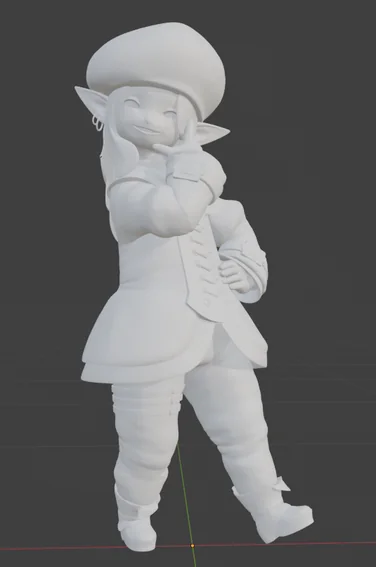
Ongoing FFXIV character-to-figurine pipeline — merging segmented game meshes into printable, detail-rich models without breaking the slicer.
AZEM is an ongoing project. I am still ironing out the problems with converting game models into printable ones — there are plenty of hurdles left with solidifying meshes, pushing detail, and keeping the slicer from rioting when it is presented with the model.
It is challenging for more than volume alone. FFXIV characters are built in a character creator, so the head, hands, arms, legs, body, and more arrive as separate models that must be merged. Poses can clip clothing into itself and that has to be fixed. Then detail has to be added, and the whole thing still has to slice cleanly for 3D printing.
It started because I grew very attached to my own character and noticed many friends felt the same. I had already turned a game model into a physical build once — the BOTW Guardian — so doing the same for the player characters we share a world with felt like a natural next step.
Additional info
Highlights
- FFXIV character meshes merged into one printable figure — clipping, solidify, and slice.
- ~15k to 1M+ polygons by hand for believable humanoid detail.
- Slicer vs detail trade-off: micro-polygons dropped, holes and artefacts — hunting the workable middle.
This project is difficult for very different reasons from the Guardian. That build was hard because I was new to 3D printing and modelling. This one is hard because it involves so much more detail. Most games keep polygon counts low so the CPU and GPU can breathe; normal and bump maps fake depth and lighting instead. With good textures, even a flat plane can look like an elaborate brick wall. In real life, the flat plane stays flat.
On the Guardian I already added thousands of vertices by hand and, with paint, it held up well in person. Humanoid characters are less forgiving — details need to be spot on or the result looks uncanny. I took my own character from about fifteen thousand polygons to over a million by hand. Then the slicer — the software that turns a mesh into printer instructions — did not cope. Many of the new faces were too small; it dropped them, leaving holes and odd artefacts across the model. The work now is finding a happy middle ground: enough detail without making the slicer panic.